Press & Media
Lebanese Media
TV
(For English subtitles, click on the CC icon and choose to translate.)
Mahmoud Amhaz: A Legacy of Lyrical Abstraction
(click on the title to open full text)
A Journey Through Art and Academia
Mahmoud Amhaz, born in 1935 in Baalbek, represents a pivotal figure in modern Lebanese abstract painting. His formal training began at the Royal Academy of Fine Arts in Liège, Belgium, where he also earned a doctorate in Art History and Archaeology. By 1964, Amhaz was staging solo exhibitions across Europe and Lebanon, eventually returning to Beirut to share his expertise as a professor at the Lebanese University starting in 1965.
Contribution to the Lebanese Art Scene
Throughout his career, Amhaz was a constant presence in the prestigious Salon d’Automne at the Sursock Museum and international events like the 1996 Sharjah Biennial. As a founding member of the Association of Lebanese Painters and Sculptors, he balanced his creative output with academic rigor, publishing numerous essays and lecturing globally on the history of plastic arts.
Analysis of “Dialogue” (Oil on Canvas)
The featured work, Dialogue, belongs to the permanent collection of the Lebanese Ministry of Culture. The piece is characterized by:
- The Figures: Three ethereal female silhouettes dominate the foreground, surrounded by subtle, suggested faces in the background.
- The Palette: A chromatic range of oranges and reds evokes the radiance of a sunset, casting an incandescent glow over the entire composition.
- Social Symbolism: Through his use of “lyrical abstraction”—a style shared by masters like Kandinsky—Amhaz elevates the female figure to a “solar” status, a deliberate and meaningful choice within the context of a traditionally patriarchal society.
- Technique: The texture is dense and expressive, utilizing fluid lines and emotional gestures to convey a sense of spiritual elevation and delicate interiority.
Context
This profile is part of the “5 de Pic” series, a co-production between the Ramzi and Saeda Dalloul Art Foundation and Télé Liban, dedicated to highlighting the evolution of formal representation in art.
(For English subtitles, click on the CC icon and choose to translate.)
Dr. Mahmoud Amhaz: The Language of Abstract Art
(click on the title to open full text)
Origins and Academic Path
Dr. Mahmoud Amhaz, a distinguished Lebanese visual artist and academic, shares his journey from his early passion for drawing to his professional evolution in Europe. In 1957, he moved to Belgium to study Archaeology and Art History, while simultaneously earning a diploma in painting from the Royal Academy of Fine Arts. His dual background as both a scholar and a creator deeply informs his approach, viewing art as a dialogue that is only completed through the viewer’s interpretation.
The Philosophy of Abstraction
Amhaz defines abstract art as a departure from “figurative” or realistic representation. While realism mimics the physical world, abstraction is an introspective process that evolves alongside human society. He notes that while modern abstraction is often associated with the West, its roots are present in Eastern traditions, such as Islamic and Byzantine art, which used non-realistic imagery to evoke spiritual rather than physical worlds.
“Virtual Faces” and Artistic Evolution
The discussion highlights a significant shift in his work starting around 2011. His previous style, which relied on geometric lines and structured fields, evolved into a more fluid and emotional exploration. His 2014 exhibition, Virtual Faces (Wujoh Iftiradiyah), consists of 25 paintings exploring the human face as a “mask” that both hides and reveals deep-seated emotions.
- Symbolism of the Face: These faces represent cries of pain and the collective tragedy of living through perpetual conflict, capturing a universal human condition.
- Technique and Texture: Amhaz rejects traditional Western “perspective” in favor of a flat, layered surface more common in Eastern art. His work often features the intricate texture of “color paste” and overlapping lines to create visual intensity.
The Viewer’s Role
For Dr. Amhaz, a painting is an open text. He encourages viewers to bring their own culture, feelings, and experiences to the work, allowing the “virtual faces” to resonate uniquely with every person who encounters them.
Printed Mídia
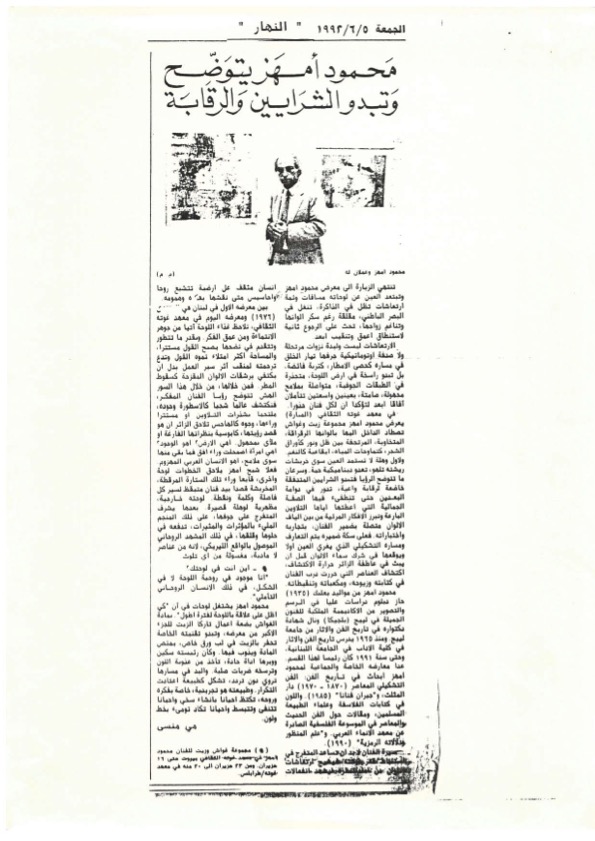
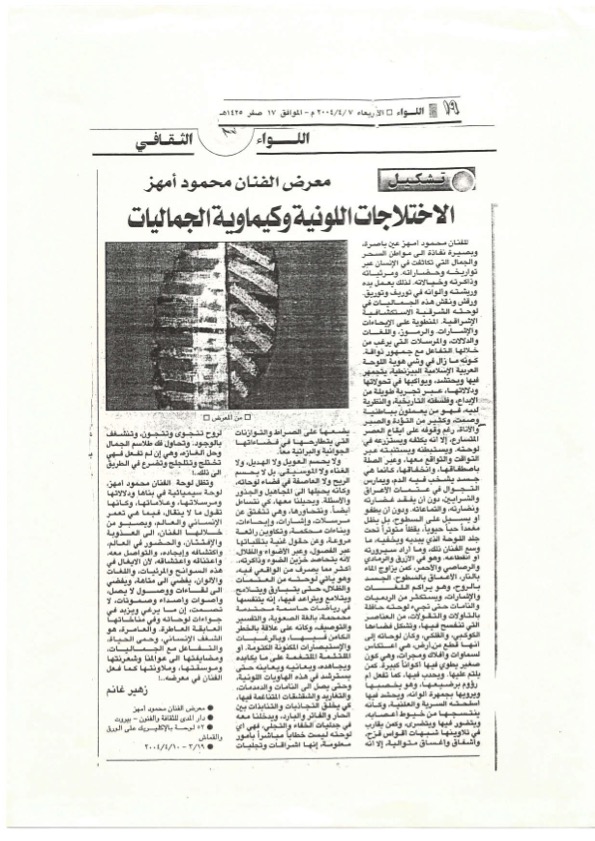
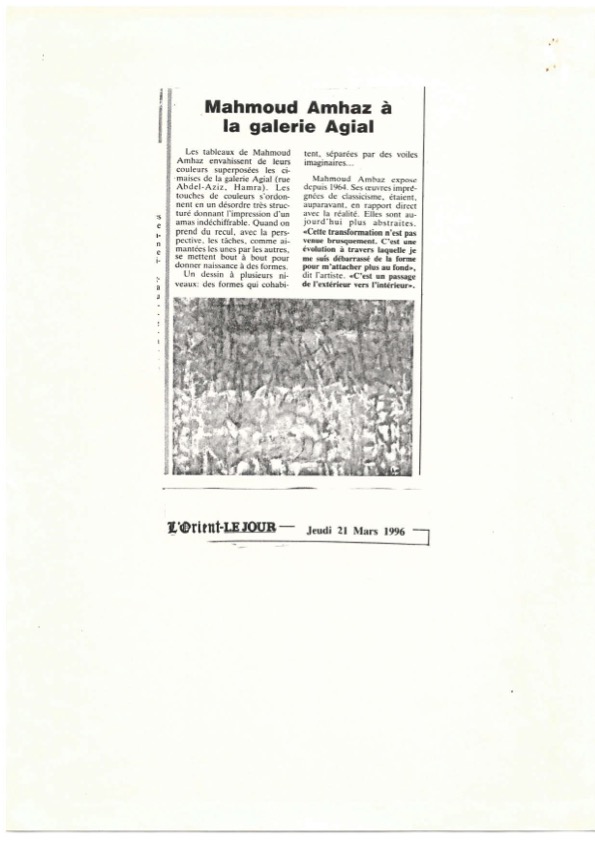
Articles with english translation


Press Image gallery