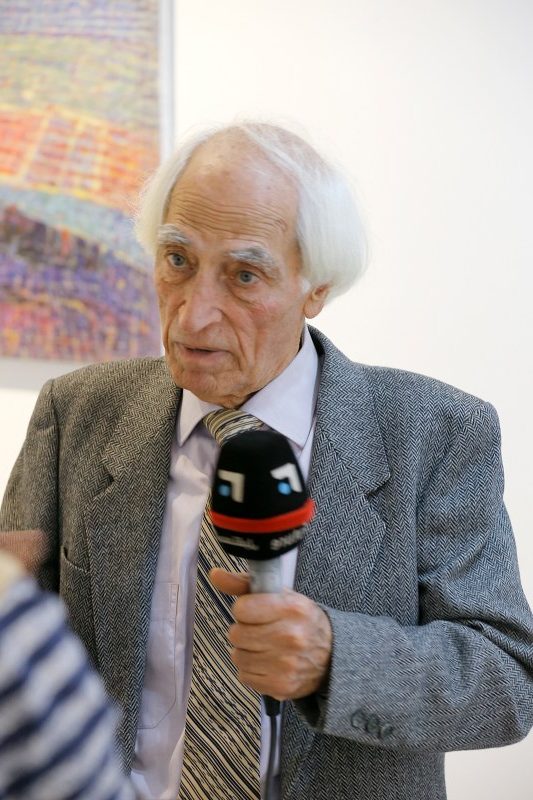
The Artist
Mahmoud Amhaz
(b. 1935)
| Bio | Artist Statement |
Bio
Mahmoud Amhaz was born in Baalbek, a city whose archaeological and historical depth played a decisive role in shaping his intellectual formation and artistic sensibility. Immersed from an early age in a landscape marked by ancient civilizations, he developed a strong awareness of structure, history, and symbolic continuity elements that would later inform both his scholarly research and artistic practice.
He pursued higher studies in archaeology, specializing in ancient Near Eastern and Mesopotamian civilizations, and completed a PhD in archaeology at the University of Liège.
In parallel, Amhaz earned a diploma in art and art history from the Royal Academy of Fine Arts in Liege Belgium. This dual academic formation archaeology and art history distinguished him as both a scholar and a practicing artist.
Upon returning to Beirut, he became actively involved in teaching, research, and critical writing in the fields of art, archaeology, and art history, while maintaining a sustained studio practice. This balance between theoretical inquiry and artistic production remained central to his career.
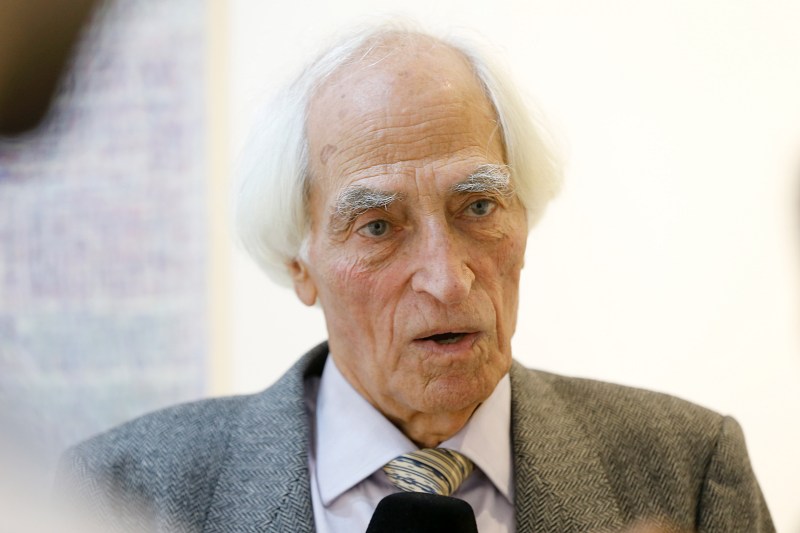
Amhaz’s artistic work is fundamentally abstract, yet never detached from meaning or cultural reference.
His compositions are structured around geometric systems verticals, horizontals, squares, and rectangles, continuously reworked through balance and rhythm rather than applied mechanically.
A defining element of his practice is his engagement with Arabic calligraphy, which he deconstructs and frees from its linguistic function, transforming the letter into line, gesture, and spatial rhythm. Writing becomes a visual experience rather than a readable text.
Situated in dialogue with Islamic and Eastern visual traditions, his abstraction differs from Western modernist models that seek complete detachment from reference. Light, repetition, and rhythm function as structural and contemplative elements within his work.
Over time, Amhaz’s painting evolved toward greater reduction and refinement, favoring internal structure, spatial equilibrium, and chromatic restraint. Subtle allusions to landscape, architecture, or human presence remain, suggested through structure rather than representation.
Mahmoud Amhaz’s work reflects a sustained reconciliation of scholarship and intuition, archaeology and abstraction, heritage and modernity, securing his place within modern Lebanese and Arab art.
Source Note
Adapted from selected passages of Lebanese Critical Perspectives on Modern Visual Art (1875–1975) (المقاربة اللبنانية للفن التشكيلي الحديث), written in Arabic by Adel Koudaih.
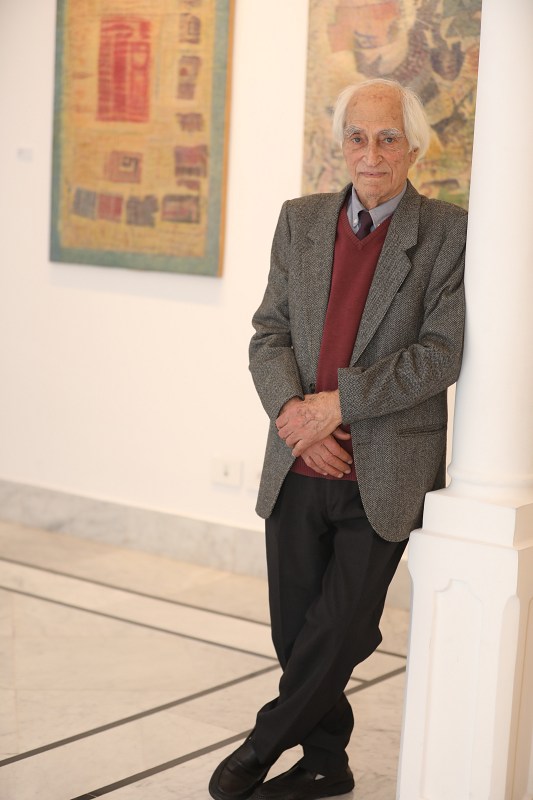
Artist Statement
The pictorial work is, in principle, addressed to the eye which, from the very moment it encounters it, becomes immersed in the vibrations of color and the interweaving of lines. The eye perceives within it what resembles letters or vague forms of writing. Images and evocative shapes enter the pictorial field, enriching it without causing the text to lose its structure or its language.
The defining characteristic of my earlier works is abstraction, though not exclusively so, since the relationship with the visible world has never been absent or severed, even when reduced to visual impressions or simple evocative signs. Even within the broader history of art, the relationship between figurative and abstract art has never been entirely contradictory, nor has the boundary between them been universally impassable. To oppose them absolutely would be an exaggeration and finds no true parallel in Eastern art. While abstraction, in Western thought, is often viewed as the opposite pole to figuration (the representation of reality as it is, wholly or partially), the imitation of reality in Eastern arts ,Byzantine and Islamic, has remained conventional: a singular formula based on interpreting visible data as a pretext for distancing oneself from the material world.
It is true that, throughout the successive phases of my work, transformation of content constituted the primary objective. Yet this transformation was accompanied by a parallel evolution in the treatment of material and in the techniques appropriate to that content. After my attention had focused on color and line, and on their use in creating a calm, calligraphic pictorial space inviting contemplation, I introduced the human figure into this subjective world without confining it to the established rules to which the eye is accustomed. The value of the image lies in the accumulation of signs it carries and in the expressive charge produced by form, line, color, and the manner in which they are treated. Most often, this image remains conventional, without any referential anchor or optical depth (without perspective), approaching the mask or the silhouette, surpassing detail, as if the intention were to express not the external appearance but the idea or inner content reflecting a human condition.
Yet the perception of values related to humanity and to the environment in which it exists does not necessarily depend on the presence or absence of the human figure. Such values may be conveyed in a work of art through line, color, and form, provided the artist succeeds in recreating suggestive effects.
The work of art is a plastic prototype that organizes relationships between things and recreates them, not in order to represent or reproduce them according to fixed data, but to express them through legible signs. Through this model, the relationships linking subjectivity and objectivity, humanity and the external world, the self and the other, become illuminated.
Dr. Mahmoud Amhaz
Beirut, 25 March 2011