Testimonials
Dr. Nassim Khoury
(1990, translated from Arabic)
Whoever contemplates the works of the artist Mahmoud Amhaz moves, at first glance, toward what may seem like abstraction. Yet it is a transparent abstraction distinguished by its clarity. He does not share this result with us until after we have shed our concepts, our measures, our titles, and our prior judgments about what lies outside and what lies within. Imitation, acquired images, reflections, functionality, and superficial visual satisfaction, all of these are shattered forms transcended by Mahmoud Amhaz’s canvases.
You encounter that primordial multiplicity of dimensions and readings when you see Amhaz’s work. He draws you toward taking up the brush yourself, continuing the formation, adding salt, touching shapes that grow and evolve into something without end.
Before you are texts with their own alphabet, almost descending outside the familiar space between alif and yaa. It is not easy, as we witness in his production, to write color with what precedes the alphabet and what comes after it, with simplicity and modesty that recall to us the materials of first creation in their primal state.
You stand before worlds and inner states resembling mirrors in their first purity, placed before magical windows, windows that resist being seen in a direct and ready-made way. It is as though the artist is saying to you: Look long into myself / yourself, and into my painting / your painting, before you arrive at any answers.
This mystical inward immersion is a form of noble bewilderment, a search for a future solution that is more complete and more harmonious with what is to come.

Will tomorrow come?
No. Tomorrow comes as dust. The dust of the human being takes shape in some of his paintings. Dust, perhaps, in the form of the clay of human molds. It remains in ambiguity, attempting clarity, yet the artist returns it to the testing ground of the self in order to refine it according to the rhythms before formation, seeking a new human being, constantly renewed and transformed.
And I believe that in this there is a profoundly eloquent form of expressing reality as lived and experienced by the artist, and within it, a deep commitment to humanity and to the spirit of the age.


The Favorite of May Gebran and Nassim Khoury
Translated from French (2020)
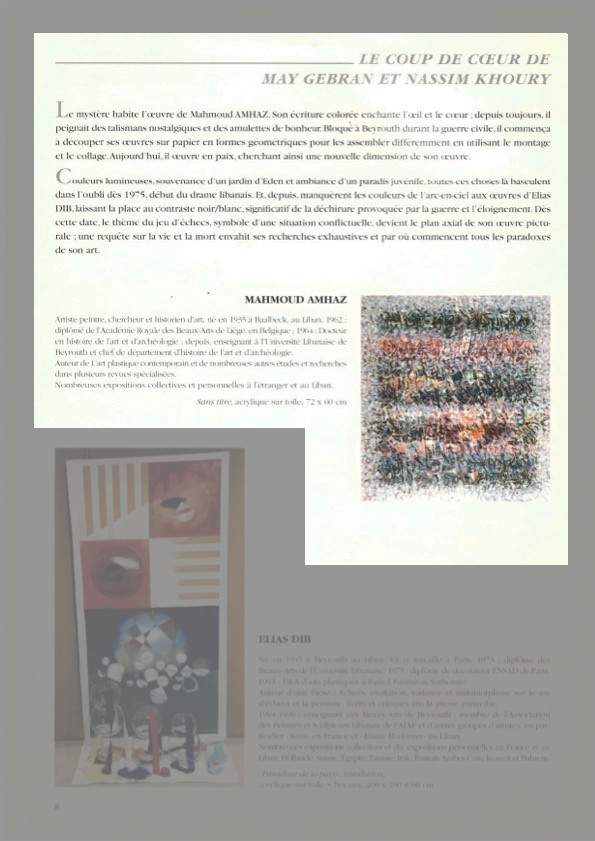
Mystery inhabits the work of Mahmoud Amhaz. His colorful expression delights both the eye and the heart; for as long as one can remember, he painted nostalgic talismans and amulets of happiness sealed within the whirlwind of war-torn Beirut. From that time on, he began cutting his works into geometric shapes in order to reassemble them differently, using montage and collage. Today, he works in peace, seeking a new dimension for his art.
Luminous colors, the memory of an earthly paradise, and the atmosphere of a youthful Eden—all of this was overturned and cast into oblivion in 1975, at the beginning of the Lebanese war. Since then, the colors of the rainbow have disappeared from Elias Dib’s works, giving way to a striking contrast of gold and lilac: a sign of the rupture caused by war and separation. From that moment, the game of chess, a symbol of conflict, became the central axis of his pictorial work; a quest about life and death permeates his exhaustive explorations, and it is there that all the paradoxes of his art begin.